 |
UNCOVERING POISON IVY: Prevent itchy mishaps
By Blair Koster
Summer foliage is lush with vines, wild grasses and poison ivy. "I would love to get the word out about poison ivy," says park ranger Kristen Miller. "Yesterday, a girl brought her mother flowers. I had to tell them she was holding a big bunch of poison ivy."
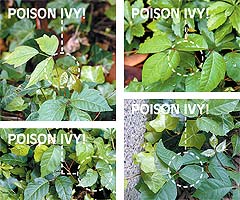 |
| All of the poison ivy above was discovered in one garden. Be wary of this plant in your own garden. |
- It Looks Like — "Poison ivy has leaves with three green leaflets, the middle leaflet often the longest. The leaflets have little points and can have smooth edges or little teeth. Poison ivy can grow as a small bush or a vine, and sometimes, it has small green and yellow flowers. Later, there are little fruits. In the fall, the leaves turn red-gold."
- How It Grows — "Poison ivy has small white berries. Birds eat them, and when birds poop, it spreads."
- Where It Grows — "It grows in woods, in flower beds, in fields, on lawns and along waterways and roads. The plant has a hairy vine that grabs onto trees. There are oils inside, a sticky resin called urushiol. When people mow the lawn and use weed eaters, the oils become airborne."
- Wear and Wash — "When doing yard work, wear long pants and gloves. Take clothes off and wash them. If you touched the plant, clean the area with rubbing alcohol within 10 minutes and rinse. Put latex gloves on and clean your shoes."
- Allergic — "An itchy rash can develop within 1 ½ to 10 days after exposure. There are blisters and swelling; the rash can look like a third degree burn. If the rash is not severe, hydrocortisone products are helpful. I like the Aveeno products. If the rash gets on your face, or if you have a severe reaction, such as swelling of the airway, see a doctor."
- Myths — If you scratch the rash, the poison ivy will spread. "That's not true," says Miller. "If you pop blisters, however, you can get an infection."
- What about Poison Oak? — "It's not common in this area. The plant looks like an oak leaf with rounded edges. Poison oak also has urushiol. Take the same precautions with poison oak as you would with poison ivy."
| Contributor: Kristen Miller, Naturalist. Pocahontas State Park, 10301 State Park Rd. Chesterfield, VA (804)796-4255 |
|
|
|
|
 Good Health