|
ALLERGY SEASON: 10 tips to get you through
Compiled by Blair Koster and Leslie Roman-Williams
With sunshine and warm days, people are pulling back their curtains and opening windows. Warm wind, foaming surf and vacation days in the sun beckon. This summer, get sun smart. Know the facts and protect yourself.
 When spring pollen comes back ah-choo When spring pollen comes back ah-choo
Michael Blumberg, MD, of Virginia Adult & Pediatric Allergy & Asthma, talks about tree allergens and allergies.
What about tree pollens? What happens in this area?
Richmond is one of the highest tree-pollen areas. The first trees generally begin to pollinate from mid-February, beginning with cedar pollen for about a week. You will see more from late March to early May: oak, birch, maple.
Which tree pollens in Richmond will cause the most distress?
Maple, birch, and especially oak, are most allergenic.
What are some of the ways we can deal with pollen around here?
VAPA offers pollen-fighting tips. Here are a few:
• Keep your clothes and hair as pollen-free as possible by washing your hair before you go to bed. Change your clothes soon after being exposed. Pollen clings to fabrics and hair. Even your pets can carry pollen around on their fur.
• Pollen counts peak from late morning to early afternoon. Avoid being outdoors during that time.
• Pollen can circulate in your home or car, so keep windows closed as much as possible. |
|
 Airing your differences Airing your differences
Spring is typically a time when you deep-clean your home - scrubbing and vacuuming those hidden spaces and laundering fabrics thoroughly.
The air in your home needs cleaning, too.
Todd Johnson and Kevin Kirsh of Midlothian Mechanical believe that a "tune up" is in order for your home air conditioning systems.
 They emphasize that EPA studies have shown that indoor air quality is several times worse than outdoor air quality. They emphasize that EPA studies have shown that indoor air quality is several times worse than outdoor air quality.
Humidity levels, such as in homes near the river, plus interior factors like carpet-based irritants, or using hair spray, will affect the air you breathe. Kevin adds, "Houses are built so tightly there is not as much fresh air."
An indoor air assessment (the AirAdvice® Report) can determine your options. Adding a media air filter may remove up to 99 percent of pollen and mold spores, and up to 90 percent of dust particles or other pollutants. Kevin says, "Putting in a media filter does such a great job" in improving air quality for conditions such as asthma. Some clients with severe allergies have reported a decrease in their use of medication. |
 Air filters are MERV-elous! Air filters are MERV-elous!
What is MERV?
Minimum Efficiency Reporting Value
It is the effectiveness rating for air filters, referring to the amount of particle removal of contaminants from the air. The higher the rating, the more effective the filter. |
|
 Shed light on your allergies Shed light on your allergies
Todd Johnson and Kevin Kirsh of Midlothian Mechanical share some information that few people may realize: A UV (ultraviolet) light kills airborne allergens and mold. Kevin references the use of ultraviolet lights in daycare centers to improve air quality. |
 When Allergies Drive You Buggy When Allergies Drive You Buggy
Indoor bug and rodent infestation is not limited to particular neighborhoods in the city, where you might think that older homes would have that problem.
Dr. Michael Blumberg remarks, "It's almost universal in this area. We're seeing more allergies from indoor insects. It is not just in the Fan or on Church Hill, we are seeing this also in Chesterfield and in the West End."
 He co-authored a research paper two years ago about a female patient who exhibited several "classic" allergy symptoms, yet it was difficult to determine the source of her distress. He co-authored a research paper two years ago about a female patient who exhibited several "classic" allergy symptoms, yet it was difficult to determine the source of her distress.
At one point she mentioned that she was exposed to ladybugs. Dr. Blumberg developed a skin test to determine if the ladybug possessed an allergen that was causing her symptoms from an allergic reaction to a ladybug protein enzyme found in the ladybugs' digestive tract. |
|
 Vacuums to HEPA your allergies Vacuums to HEPA your allergies
The 2006 National Health and Nutrition Examination Survey results, provided by Miele Inc., indicate 54.3 percent of individuals tested had a positive response to at least one of ten allergens in the survey. Could a new vacuum cleaner help?
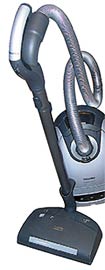 |
| The Miele Capricorn. $1,149.00 at Willett Vacuum. |
Peter Vinci of Willett Vacuum says, "When you're vacuuming, you're stirring up dirt; you're throwing around more stuff that's in the air."
The correct vacuum, Vinci says, "is your A-1 defense against allergens." Some customers reported a decreased need for allergy treatments after using vacuums from Miele. The entire mechanism of the vacuum, not only its HEPA (High Efficiency Particulate Air) filter, but also its bag and Sealed System™ technology that collects particles that would otherwise escape into the air, have been proven to enhance air quality.
This results in air that is "cleaner than air that's in your room," says Vinci. He recommends that filters be replaced yearly.
Vinci emphasizes, "Bagless vacuums are not good for allergies." |
|
 Pillow talk Pillow talk
You may find it hard enough just to force yourself out of bed each morning. If you start your day with sneezing and wheezing from what is embedded in your pillows, all the worse. These pillows will not bring you your morning espresso or play your favorite wake-up music, but they may soothe you with their anti-allergenic properties. Sweet dreams!
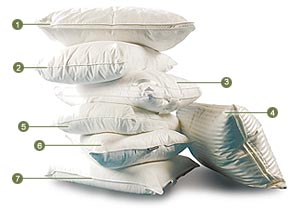
- Nobility® 350-thread count Primaloft® Luxury Down Alternative. 100% cotton woven damask, machine washable and dryable, hypo-allergenic. $35.99 at Dillard's.
- Plush brushed-cover pillow, polyester fiberfill hypo-allergenic. $4.99 at Target.
- Wamsutta® Magic Gel. The affordable alternative to down. 300 thread count 100% cotton cover hypo-allergenic. $14.99 at Linens-N-Things.
- Deep Pockets® smooth, even sleep surface, squared off sides hypo allergenic polyester fiberfill. $2.92 at WalMart.
- Memory Foam premium combo bed pillow. Microfiber fill offering gentle soft comfort. $39.99 at Target.
- Allergy Relief with Silpure® the natural anti-microbial treatment. Durable construction for hot water wash. $26.00 at Macy's.
- Pinnacle® Allergy-free down pillow. 700-fill power Siberian white goose-down 400 thread count silk/cotton cover. Lifetime warranty. $99.99 at Bed Bath & Beyond.
|
 Watch what you eat... really Watch what you eat... really
The most common food allergies among adults are peanuts, shellfish, tree nuts, fish, and eggs. In children, eggs, milk, peanuts, soy, and wheat are the primary allergens. According to researchers at the National Institute of Allergy and Infectious Diseases, only 1.5 percent of adults and up to 6 percent of children younger than three, about 4 million people in the United States, have a true food allergy. Still, an estimated 150 Americans die each year from severe allergic reactions to food.
Symptoms of a food allergic reaction can appear minutes to two hours after eating the food and can include tingling of the mouth and tongue, throat swelling, trouble breathing, hives, vomiting, abdominal cramps, diarrhea, drop in blood pressure, loss of consciousness, and death.
Life can get tricky. Unlike the allergens of cats, dogs, or ragweed, food allergens are not so easily avoided. What to do? Read labels very carefully and cook your own food. Don't eat out. You don't know how food is prepared in a restaurant or under what conditions, and it isn't protected by the Food Allergen Labeling and Consumer Protection Act (FALCPA).
FALCPA went into effect on January 1, 2006. The law requires food manufacturers to list the word "contains" and the allergen's name in plain English. FALCPA's requirements apply to all packaged foods sold in the United States and regulated under the Federal Food, Drug, and Cosmetic Act, including both domestically manufactured and imported foods. Congress has identified eight foods or food groups as major food allergens protected by FALCPA: milk, eggs, fish, crustacean shellfish, tree nuts, wheat, peanuts, and soybeans. To learn more, visit the FDA Web site at www.fda.gov.
Locally, Good Foods Grocery has a new service. Consumers can visit the store online at www.goodfoodsgrocery.com and perform a product search. Simply select the ingredients you are allergic to, and a large selection of foods without this ingredient appears. |
|
 Not a cat to sneeze at... Not a cat to sneeze at...
Love cats, but not the way they make your eyes water? Allerca, a biotechnology company based in San Diego, has produced the world's first hypoallergenic cat. The allergy-causing protein found in cats' skin and saliva has been virtually eliminated from these sneeze-proof felines. The firm offers a one-year money-back guarantee, and it's probably a good thing…these kitties come with a price tag of $3,950, plus transportation charges. Your kitten will be delivered by private jet courier and hand-delivered to an Allerca-certified veterinarian for pick-up. Hailed as one of Time magazine's best inventions of 2006, there's already a long waiting list. For more information, visit www.allerca.com |
|
 Dust, and mites, and allergies, oh my! Dust, and mites, and allergies, oh my!
According to information from Virginia Adult & Pediatric Allergy & Asthma, ten to twenty percent of the American population will become allergic to dust mites.
Virginia is an area in which dust mites are common because they thrive in our humid, mild climate, especially when the temperature is gauged between 70 F and 80 F.
 Michael Z. Blumberg, MD, MSHA, is a board-certified physician at VAPA (Virginia Adult & Pediatric Allergy & Asthma) with local offices in Richmond, Midlothian, and Mechanicsville. (804) 288-0055. Michael Z. Blumberg, MD, MSHA, is a board-certified physician at VAPA (Virginia Adult & Pediatric Allergy & Asthma) with local offices in Richmond, Midlothian, and Mechanicsville. (804) 288-0055. |
Dr. Michael Blumberg comments, "The late autumn and winter weather, with cold, dry air, kills dust mites temporarily." He adds that there is increased evidence of dust mites "when the weather starts to warm up."
These mites are too small to be seen by the naked eye and they have transparent bodies, thus we are not usually aware of their existence on our bedding. They eat the flaky skin that we humans shed. Yuk!
Dr. Blumberg notes that dust mites can penetrate through spaces between fibers of fabrics. They are not particularly airborne but cling to textiles such as linens and rugs.
How can you make a "clean sweep" to eliminate mites? VAPA recommends:
• Use plastic covers or permeable fabrics to cover mattresses and pillows.
• Launder with water of at least 130° F.
• Vacuum more frequently behind "dust-bunny"-collecting areas like behind or under beds.
• Remove as much carpeting as possible. |
|
|
|
|
 Good Health